Northern Europe Sees the Value in Bike-Friendly Cities. Britain is Falling Behind.
By Connor Glaze
If you’re a cyclist in any major city in the UK, you’ve probably been frustrated by the lack of bike-friendly infrastructure at least once.
The awkward feat of having to rear your bike onto its back wheel to get past someone in a narrow foyer, and hugging the left-hand kerb while the most impatient driver in the world tears past a little too close are just a couple of the greatest hits British cyclists have to contend with.
Across the channel, however, things are very different.
Amsterdam, Gothenburg, and other northern-European cities put enormous effort into building end-to-end cycling infrastructure that accommodates, rather than marginalises cyclists. Often, these provisions are built from the beginning - an integral part of the planning for residential and public buildings, and even legally required by some municipal building codes.
Britain, sadly, is lagging behind our neighbours on the continent in terms of secure storage, basic urban infrastructure, and other areas.
Here’s the story of how we ended up here, what continental Europe is doing differently, and the changes our nation could make to become a better place to cycle.
The Great British Barrier to Cycling
7-8 million people in the UK cycle at least once per week, roughly 11% of the total population.
That’s a lot of cyclists, but the nation where they live doesn’t always make life easy…
-
48% of people who don’t cycle say safety concerns are a barrier, and 52% want more off-road or segregated cycle paths. [National Travel Attitudes Study]
-
43% of people want to cycle more, and 42% say they often use a car because no other transport options are available. [Walk Wheel Cycle Trust Walking and Cycling Index]
While simply having safe routes to ride is a major blocker, things aren’t much better when it comes to storage and security.
-
51,990 bikes were reported stolen in England and Wales in 2025 [CrimeRate]
-
4,139 bikes were stolen from train stations in 2024, but only 22 suspects (0.5%) were formally charged. [Crush Crime via Road.cc]
-
72% of UK cyclists say that worries about where to leave their bike discourages them from cycling more. [Cycleplan]
-
64% of UK cyclists have brought their bikes into living spaces because they don’t trust alternative storage. [Cycleplan]
-
60% of people on low income say that secure cycle storage at or near their home would help them cycle more. [Walk Wheel Cycle Trust]
When it comes to encouraging more people to get on their bikes, the government and local authorities tend to focus on road access and building new cycle paths. However, a large chunk of the friction starts at home, with a lack of secure storage, restrictions on using shared spaces, and a prevailing fear of theft.
This state of affairs is a far cry from nations like Germany and the Netherlands, where proper cycle storage is not only widely available, but legally required in the building codes of some municipalities.
This begs the obvious question…
How Did We Get Here?
There’s a common misconception that certain European countries have always had a strong cycling culture that Britain simply lacks. The reality is more complicated.
In the early 20th century, cycling was widespread across northern Europe, including here in Blighty. Cities like Cambridge, Oxford, York, and many industrial centres had substantial cycling rates. Just like in the Netherlands, the humble bicycle was a common form of transportation, especially for workers and schoolchildren.
This all took a drastic turn in the 1950s-1970s.
Across Europe, the post-war planning ideology was that the future belonged to the car. Governments widened their roads, built motorways, and demolished whole neighbourhoods for efficient traffic networks. Everywhere you looked, nations were prioritising cars, which were rapidly growing from a luxury of the rich to a more accessible mode of travel.
Though it seems strange now, the powers that be admired American-style road systems, and saw mass motorisation as a sign of prosperity. By the late 1960s, cycling was declining everywhere in Northern Europe in favor of the new motorised future.
Why the Netherlands Changed Course
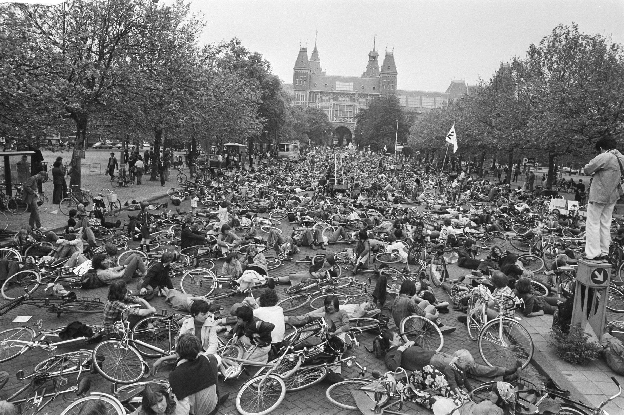
The Dutch return to a more “cycling-first” society was rooted in two related crises.
First, traffic deaths rose dramatically in the Netherlands through the 1960s and 70s due to the sudden uptake in cars. The number of children being killed in traffic collisions was particularly shocking, and even led to the start of a “Stop de Kindermoord” movement against car-dominated urban planning.
Second, the 1973 oil crisis hit Europe hard. With a global shortage of petrol, the vulnerability of a transport system dependent on oil became obvious. Thanks to an economic shock started by conflict in the Middle East, cycling suddenly became part of a viable economic strategy, rather than an old-fashioned way of getting around.
The Dutch government introduced car-free Sundays in the peak of the crisis, but policymakers also decided to respond on a structural level, redesigning cities with:
-
Protected cycle lanes.
-
Traffic-calmed neighbourhoods.
-
Filtered streets that discouraged through-traffic.
-
Safer intersections.
-
Lower speed limits in built-up areas.
Around this time, Denmark followed a similar course spurred on by the same factors, and while Germany was more of a mixed bag, there were still concentrated pushes towards developing cycle-friendly infrastructure in cities such as Münster and Bremen.
Britain, meanwhile, saw a slow but certain decline in cycling uptake. This removed the kind of political pressure that was driving change on the continent, and created a negative feedback loop: fewer cyclists means less political pressure, means less infrastructure, means even fewer cyclists.
The Netherlands, Denmark, and other nations never crossed this threshold to the same degree, and the results are starkly visible today.
Where We Are Now
2026 is a great year to be a cyclist in many places on the continent, and the data on cycling uptake from the past 5 years reflects this:
| Country | National Modal Share (% of Trips) |
|---|---|
| The Netherlands | 27-28% |
| Denmark | 13.7-15% |
| Belgium | 16.5% |
| Germany | 12% - 17% |
| UK | ~4% |
Sources: UK Government National Travel Survey: Active Travel Statistics [1], KiM Netherlands Institute for Transport Policy Analysis Cycling Facts Document [2], Next Mobility Belgium Federal Home-to-Work Travel Analysis [3], ECF Technical Report on Climate and Shift Potentials in Germany [4], European Cyclists' Federation Pan-European Policy Assessment [5]
Some of the most successful cycling nations in Europe haven’t simply made more cycle lanes, but also created complete urban systems that make cycling convenient, practical, and safe from door to door.
Forward-Thinking Infrastructure
The Netherlands, as usual, is a global benchmark for cycling infrastructure. A network planning approach, rather than smaller isolated projects, has helped build protected intersections where cyclists are physically separated from turning traffic. Big cities also benefit from cycle streets (fietsstraten), where cars are permitted, but cycling is still the dominant mode and motorised vehicles are essentially there as guests.
Copenhagen has made a similar leap by pioneering the concept of cycling superhighways (cykelsuperstier), with routes designed for daily commuting, complete with high-quality surfacing and winter maintenance comparable to standard roads.
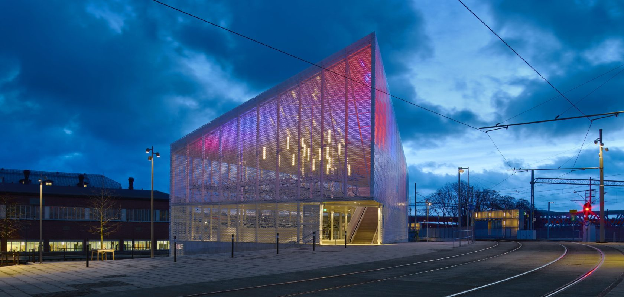
In Gothenburg, Sweden, the Gamlestaden Bicycle Parking House stands out as an instructive example for any urban planners looking to develop more cycle-friendly cities. Designed by the Sweco engineering group, this impressive facility has 600 secure bicycle spaces, multi-storey dedicated bicycle parking structure, repair and maintenance facilities, as well as e-bike conveyors on stairways.
Evolving Building Codes
Europe’s cycle-friendly approach is not only visible in specific infrastructure projects, but also the legislation that regulates all construction projects in a given municipality.
France
Though it isn’t held up as an especially cycle-friendly country, France now has some of the strongest legal requirements catering to cyclists out of any nation in Europe.
French building codes now require secure bicycle parking in many categories of new buildings, including:
-
Residential developments.
-
Office buildings.
-
Shopping centres.
-
Cinemas.
The Netherlands
Dutch municipalities, perhaps unsurprisingly, routinely require bicycle parking through local planning regulations and parking standards.
These are built around an underlying assumption that residents in the Netherlands will own and regularly use bikes. Consequently, secure storage is approached similarly to any other essential infrastructure, such as car parking, waste management, or utilities.
Though it varies from one region to another, these requirements commonly apply to new apartment buildings, educational facilities, and retail developments. Many municipalities specify minimum numbers of bicycle parking spaces per dwelling or per square metre of floor space.
Germany
German states (Länder) are increasingly weaving bicycle parking requirements into their building regulations, including:
-
Minimum cycle parking in new residential developments.
-
Bicycle parking for workplaces and commercial premises.
-
Requirements linked to building size and occupancy.
On top of this, many cities including Berlin, Munich, and Hamburg all supplement their state regulations with more specific, localised ordinances, establishing detailed parking standards. This means that secure bicycle storage is routinely included in new housing developments, rather than retrofitted as a later afterthought.
What Europe Does Differently
The diverging paths of the UK and some of its neighbours has a variety of causes. However, the current state of affairs can be attributed to a few key differences that are now part and parcel of cycling cultures here and on the continent.
Here are the major differentiators we’re seeing in the Netherlands, Denmark, and other parts of Europe, which British planners and policymakers could learn from for a more bike-friendly future.
Bike Storage is Prioritised From the Start
In the Netherlands and Denmark, bike storage is often treated the same way our architects deal with car parking: a basic necessity that has to be planned from the design stage.
A new apartment block in the works isn’t considered complete simply because it has lifts, bins, and car parking. Developers are instead expected to consider things such as where residents store the bicycles they use on a daily basis, how families will store multiple bikes, and whether people can access their storage without having to awkwardly lug their bikes up several flights of stairs.
This is especially visible in cities with official planning guidance that treats bike parking as a design question, requiring early decisions about users, capacity, and accessibility.
British developments, on the other hand, still treat storage as an afterthought, designing housing around cars first, prioritising garages or parking spaces, then (maybe) finding leftover space for bikes.
Bicycle Parking is Treated as Urban Infrastructure, Not Just Private Storage
Major cities in northern Europe often treat cycling infrastructure with the same importance as roads, stations, and public transport. One of the clearest examples of this can be seen in Dutch railway stations, where large and well-maintained parking facilities are integrated with transport systems because bikes are seen as a normal part of the journey.
Here in Britain, cycling policy is kept separate from transport planning. A lot like housing developments, train stations focus on providing space for cars and passengers, rather than bike integration. This is at least a part of why train stations in the UK have become a hotspot for bike theft.
A Brighter Future
The current state of Britain’s cycling infrastructure may look bleak when you compare it to some of our neighbours on the continent. This is especially true when you take a trip yourself, and see bike-friendly infrastructure that works with the surrounding city, rather than against it.
However, that doesn’t mean that we’re going to be stuck like this forever.
New cycling infrastructure in the UK isn’t just being led by dedicated enthusiasts and government bodies. Across the UK, we’re seeing a more universal movement towards accessible cycling, driven by local campaign groups, community workshops, and everyday residents who want their streets to work differently.
The most encouraging part in all this grassroots energy is that it reflects a pattern we saw in the Netherlands 50 years ago. The Dutch cycling culture wasn’t a single government project that was conceived and executed by stuffy bureaucrats, but something that was nurtured piece by piece, driven by communities’ concern about dangerous traffic conditions, parents demanding safer streets for their children, and residents who believed cities should be built for people, not cars.
It’s taken us a while, but Britain is now seeing similar conversations take place.
Cycling UK, the country’s largest cycling charity, runs their Big Bike Revival programme, which focuses on encouraging people who may not see themselves as “cyclists”. This programme provides confidence-building guided rides and workshops on maintenance, designed to make cycling feel more like a normal, everyday activity, and less like a niche hobby.
On a more local level, co-operatives like the Bristol Bike Project and Manchester’s Platt Fields Bike Hub provide volunteer-led, free or affordable maintenance, tools, and workshops to help people get the most out of their bikes.
State and local government initiatives are also moving in the right direction, albeit slowly.
Compared to just a decade ago, cycling infrastructure in the UK is increasingly being designed as a cohesive, connected system, rather than a loose mesh of separate lanes. This exact principle is a big part of what transformed cycling in the Netherlands: people are far more likely to get on their bikes when routes are continuous, safe, and genuinely useful for day-to-day journeys.
Some of the biggest developments include:
London’s Cycleways: London has been one of the UK’s most ambitious cities for cycling infrastructure, expanding its protected Cycleways network from around 90km in 2016 to more than 360km by 2024.
Manchester’s Bee Network: Greater Manchester is taking a more regional approach to improving infrastructure with its Bee Network, developing a large-scale web of interconnected walking, cycling, and public transport routes.
Cambridge’s Dutch Cycle Streets: Cambridge is experimenting with introducing the Dutch fietsstraat concept to the UK, by turning Adams Road into the nation’s first “cycle street”, where motorists will have to give way to bikes.
Though the change may be a little slow for many cyclists’ liking, these projects are important because they represent a change in thinking. The goal is no longer simply providing cyclists with the minimum space to ride, but creating environments where children, families, and everyday commuters feel comfortable choosing a bike to get around.
With a bit of luck, and continued pressure from an increasing number of Britons getting on their bikes, we’ll begin to see a nation that’s much more aligned with the forward-thinking cycling infrastructure we see in other European nations.
For more cycling insights, be sure to follow us on social media, or click here to discover how myBikeCloud is working to fix the problem of secure cycle storage across the UK.